
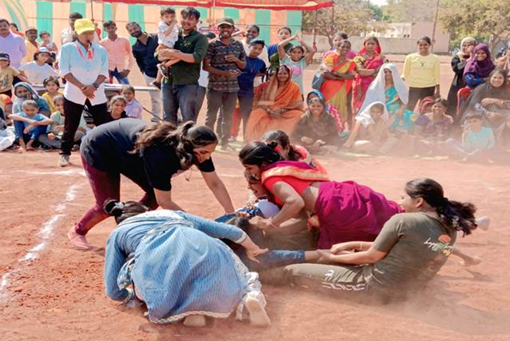
Women’s bodies and mobility have long been subjected to control by patriarchal social norms in order to keep them subservient. This control begins from an early age when a girl is restricted to indoor activities rather than outdoor play. Puberty further introduces stricter boundaries, earlier curfews and supervised movement beyond the home. For women in rural Maharashtra or Marathwada, where girls are mostly married between the ages of fourteen and eighteen, this control gets reinforced before it has any real chance to loosen.
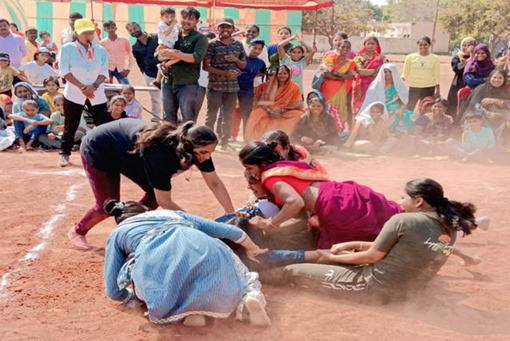
This is followed by a life lived in a near-total cycle of domestic labour restricting women to cooking, cleaning, raising children, holding a house together and having no time, no permission and no memory left of physical leisure or to simply play, let alone sport, which remains coded as a male domain.
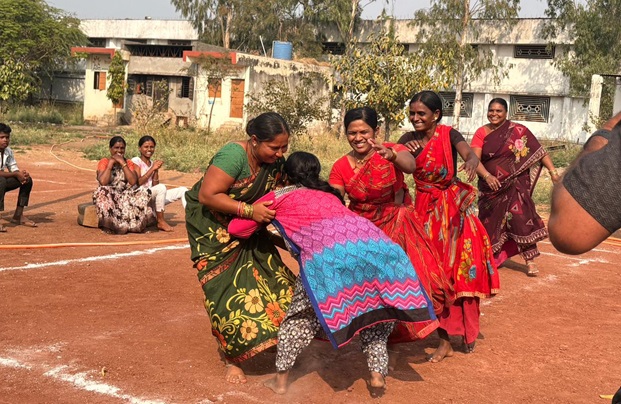
Kabaddi, mirroring this gender order, has traditionally been a men’s sport. Played on an open ground, it has easily welcomed men, leaving women to be spectators at best. In 2023, the Ekal Mahila Sanghatana, CORO India’s Single Women’s Collective in Marathwada, decided that this needed a change and set out to disrupt the gender order. They organised an all-women Kabaddi tournament in the region, the first of its kind, which drew nearly 1,400 women players from 154 teams across 220 villages in four districts with over 2,750 women cheering them on. For many women who turned up to play, the event meant much more than a sporting event. It was an assertion of their right to occupy public space and to exercise control over their mobility in their own terms, in a setting from which they were deprived.
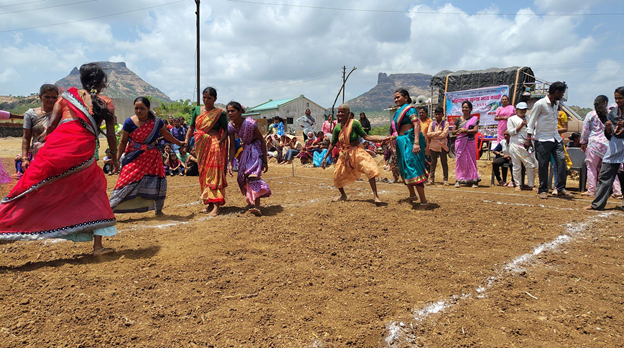
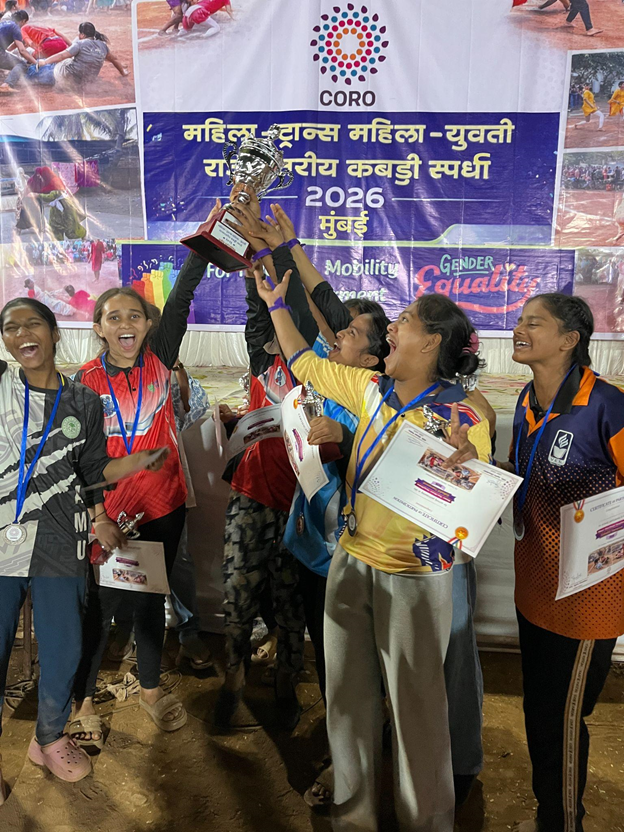
Starting from 2023, this initiative has grown into a sustained process. In 2024 it expanded to 280 villages with 594 women players and over 2,094 spectators. In 2025, around 1,683 women aged 18 to 70 participated in a Kabaddi tournament across Marathwada, playing in 187 teams while 3,300 women attended to watch. In Mumbai, the tournament saw 314 women and 10 trans women taking part, from 36 teams. Since 2023 to 2025, more than 4,000 women and 27 trans women have actively stepped on Kabaddi ground, playing a sport that was traditionally never theirs and have challenged social norms that dictate where their bodies are and are not permitted to be.
Though numbers are always interesting, what they don’t fully capture is how deeply contested a single match can be, but a narrative from Ambajogai makes that visible. While playing for her team, Jayashree Patil injured her hand and was substituted by the referee’s suggestion. After sitting out for a brief period, she returned to the field, saying, “My hand is fine,” and continued playing for that round and for two to three more rounds after that. Later that evening, when someone pointed out that while her teammates had worn sports clothes, she had played the entire match in a saree, her response was simple yet deep. She had not informed anyone in her family that she was going out to play, only that she had other work, so wearing sports wear was never really an option for her. Her account is a clear illustration of how women’s access to leisure, physical autonomy, and public space remains conditional and something to be claimed in secrecy.
Other participants also expressed similar reclaiming of freedom and joy. Rukmini said, “Playing, shouting and being on the ground made us realise how much we had bottled ourselves up over the years.” She also said, “This might not be a very big thing for many women in the cities, but for women like us, it is a once-in-a-lifetime experience,” which highlights the importance of such initiatives. Mahananda Chavan viewed these matches as a slow yet steady change towards equality.
These tournaments, alongside promoting women’s physical mobility, emerged as an entry point for these women to speak the unspoken. CORO, rightfully utilising these tournament venues in Mumbai and Marathwada, set up counselling stalls on gender-based violence, where women approached volunteers to seek support. For women, the physical act of playing itself has worked to build self-consciousness and autonomy over their bodies.
Kabaddi not only boosted women’s mobility but also gave a positive push to fading out bold lines of class, caste, status. Women from different classes, castes played together and strengthened the sisterhood. Tribal women shared that, the first time they felt included while playing Kabaddi with rural women.
CORO India is currently scaling this process across Maharashtra and wishing to start this process in Rajasthan next year, using team creation as a method of grassroots organisation rather than simply a logistical activity. Each village/community that CORO operates in begins the process through meetings with women’s collectives, support groups and self-help groups. These meetings create a shared understanding of the initiative’s significance, followed by sessions on self, gender, and social norms, after which the team can emerge organically. To strengthen local leadership, local women with sports experience are identified and supported to serve as coaches for each team, including a 70-year old aji who stepped in as a coach and broke age barriers. After about a month of training, teams participated in block-level and district-level tournaments. We are proud to say that, in 2026 around 5000 women and trans women and girls participated directly, in 509 teams playing 167 matches across Marathwada, Western Maharashtra, Vidarbha, North Maharashtra, Mumbai and Kokan, with a total outreach of close to 96,000 women, trans women and girls as athletes, participants, and spectators. Working together on this initiative, over a hundred grassroots organisations, including Mahila Mandals, community-based organisations, and CORO’s own thematic programmes, extended their support.
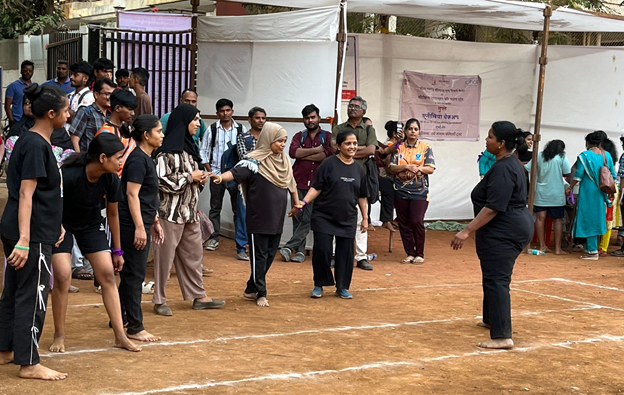
This initiative, which started as a single tournament in Marathwada, has slowly emerged as an infrastructure for a wider movement, through which women are not just simply learning to play and participate in a sport, traditionally reserved for men, but are also taking up space and reclaiming autonomy over their bodies and mobility.